Student-Based Funds
The Basics
Each school begins with expected student enrollment counts for the upcoming year. This is an estimated number of students by grade as well as students who receive special education, multilingual, and other services. It also includes projected at-risk. Schools will receive additional funds to support students with greater needs. Schools that serve special student populations will receive additional dollars to support those students’ needs, which include services for Multilingual Learners (formerly known as English Learners), Special Education (SPED), Pre-K, and at-risk students. With a focus on school enrollment, the model provides a strong foundation for every student in every school across the District.
Below is an example of two different sample students. Ella attends general education classes and does not require additional academic or language support. Mark attends general education classes and receives special education and Multilingual services. This image shows how the intention behind student-based budgeting: schools receive funding based on student need. Since DCPS budgets are based on projection, schools receive dollar amounts based on the projected numbers of students for each category with a weight.
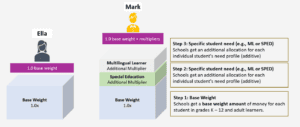
DCPS School Funding Model Student-Based Weights
Below is a chart outlining the base weight and supplemental weights in the Student-Based Budgeting (SBB) portion of the funding model for FY27. As displayed above, weights are additive, thus the per student funding amount of a specific student will vary based on the multiple categories they may fall into.
Category | Description | Weight | Weight Amount |
Base Amount | Provided for each non-PK student | 1.0 | $7,375 |
Early Childhood Education | Provided for each PK-3 and PK-4 student | 0.3 | $2,213 |
K-8 Education Campus | Provided for each K-8 student at Education Campuses | 0.25 | $1,844 |
Multilingual Learner | Provided for each student designated as a Multilingual Learner | 0.3 | $2,213 |
Special Education | Provided for each student receiving special education services | 0.3 | $2,213 |
At-risk greater than 40% | Provided for number of students above 40% of at-risk compared to total enrollment | 0.2 | $1,475 |
At-risk Secondary greater than 70% | Provided for number of grade 6-12 students above 70% of at-risk compared to total enrollment | 0.2 | $1,475 |
Early Learning Center (ELC) | Provided for each student at Military Road and Stevens Early Learning Center | 0.85 | $6,269 |
Special Education Campus | Provided for each student at River Terrace Special Education Campus | 0.45 | $3,319 |
To understand the amount of a school’s student-based budgeting allocation by supplemental weight type, review this equation below.
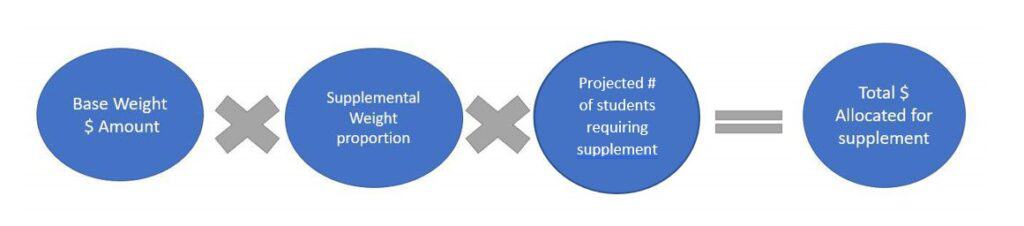
For example, for a K-8 Education Campus with 300 K-8 students, $553,125 of their Student-Based Funds will be from the Education Campus weight. This was calculated by multiplying the base amount ($7,375) by the EC weight (0.25) by the number of students who are included in that group (300). In the case of the K-8 Education Campus, the students part of the group is the entire school. However, for Multilingual Learners the number of students will just be those identified as Multilingual Learners, and for the at-risk concentration weight it will be for the student count once the 40% threshold is reached.